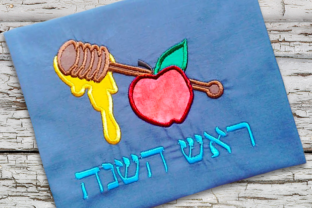
Rosh Hashanah Apple and Honey Applique
First Impression: Festive, Warm, and Thoughtfully Cultural
As an embroidery designer who’s prepped over 200 craft fair booths—and shipped thousands of embroidered handmade products—I immediately recognize Rosh Hashanah Apple and Honey Applique as a standout in the Holidays category. It reads as festive without being loud, meaningful without being overly literal, and sweetly traditional without leaning into kitsch. The apple-and-honey motif is instantly legible, and pairing it with Hebrew lettering grounds it in authenticity. It’s not farmhouse, not minimalist—it’s warm, intentional, and quietly premium. That matters when your booth has 37 other vendors selling “fall” or “Jewish holiday” items.
Where This Design Shines On Craft Fair Products
This machine embroidery design thrives where cultural resonance meets tactile charm. Here’s how it performs across top-selling handmade product types:
- Tote bag design: Centered on a natural canvas tote, Rosh Hashanah Apple and Honey Applique reads clearly from six feet away—especially with high-contrast thread colors. Customers gravitate toward it as both gift and personal statement.
- Apron embroidery: Placed just above the pocket or centered on the bib, it adds heirloom warmth to kitchen-ready handmade products. The honey wand detail reads beautifully at 3.5"–4", reinforcing quality craftsmanship.
- Tea towel embroidery: Works best on lighter linen or cotton tea towels. The apple shape anchors the composition, while the Hebrew text invites closer looking—a subtle conversation starter at market tables.
- Embroidered patch: As a sew-on or iron-on patch, this design becomes a versatile small shop product. Ideal for Etsy sellers bundling Rosh Hashanah gift sets (e.g., honey jar + patch + card).
- Pillow cover & fabric pouch: On textured fabrics like linen-blend pillow covers or drawstring pouches, the applique technique gives dimension that flat prints can’t match—boosting perceived handmade value.
- Caps & market bags: Use with caution. The Hebrew lettering may lose clarity on curved cap surfaces or dense canvas market bags unless resized and re-digitized for stability. Stick to flat, smooth areas.
What Makes It Sell—And What Requires Extra Care
Rosh Hashanah Apple and Honey Applique succeeds because it’s emotionally resonant *and* production-smart—but only if you respect its nuances. Its strength lies in immediate recognition: apple = sweetness, honey = blessing, Hebrew = tradition. That clarity helps customers connect in under three seconds—the average time spent scanning a craft fair display.
However, practical execution demands attention:
- Stitch density matters: The honey dipper in the 4×4 version is fully embroidered—not fused—which means tighter fills and potential puckering on thick or stretchy fabrics. Always test on scrap with your intended stabilizer.
- Small lettering risk: Hebrew characters are elegant but compact. Below 2.25", spacing tightens and legibility drops—especially on textured towels or dark fabric. Avoid scaling down for patches smaller than 2.5".
- Fabric texture changes everything: A looped terry cloth tea towel will swallow fine details; a tightly woven linen apron makes them pop. Match fabric texture to design intent.
- Thread contrast is non-negotiable: Gold or amber thread on ivory linen? Yes. Light yellow on cream canvas? Risky. Always hold swatches side-by-side before stitching.
Real-World Booth & Online Impact
In person, Rosh Hashanah Apple and Honey Applique elevates your visual hierarchy. When grouped with neutral-toned handmade products, it draws eyes without shouting. Paired with real honey jars, cinnamon-scented sachets, or hand-poured candles, it strengthens thematic cohesion—making your booth feel curated, not cluttered.
Online, it photographs exceptionally well for Etsy listings and printable mockups. The clean shapes and balanced negative space translate cleanly to thumbnails and mobile views. Just ensure your lighting captures thread sheen and fabric drape—those details communicate handmade quality faster than any description.
For digital embroidery file sellers, this design has strong repeat potential: it fits neatly into seasonal collections, pairs well with Passover or Sukkot files, and appeals to niche-but-loyal audiences (Jewish educators, synagogue gift shops, interfaith families). Its specificity is an asset—not a limitation.
Essential Embroidery Designer Notes Before Production
Before cutting fabric or loading your hoop, run these checks:
- Test the design on scrap fabric *with your exact stabilizer and thread colors*—not just a generic sample.
- Review spacing between Hebrew letters and the apple graphic. Tight kerning can blur on low-density fabrics.
- Confirm hoop size compatibility. If marketing a “4×4 version,” verify no element exceeds 3.9" in any direction.
- Inspect stitch density in the honey wand area—dense satin stitches need stronger cutaway stabilizer on knits or lightweight cotton.
- Create at least one real mockup (e.g., stitched on a tea towel) before photographing for Etsy or social media.
- Compare fabric color swatches side-by-side: light fabric shows thread richness; dark fabric demands metallic or high-contrast threads.
- Confirm commercial licensing terms. If selling finished products (not just the embroidery file), ensure the design permits commercial embroidery use.
Final Verdict: A High-Value, Low-Risk Craft Fair Staple
Rosh Hashanah Apple and Honey Applique isn’t just another holiday embroidery file—it’s a strategic small shop product. It balances cultural specificity with broad handmade appeal, performs reliably across multiple product categories, and signals care in both design and execution. For Etsy sellers, boutique makers, and craft fair entrepreneurs, it’s the kind of embroidery design that turns browsers into buyers, gifts into keepsakes, and seasonal inventory into year-after-year staples. Just remember: honor its details, test early, and let the sweetness speak for itself.