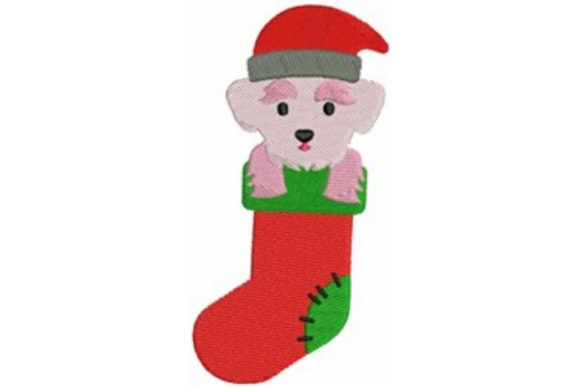
Christmas Maltese: A Thoughtful Embroidery for Meaningful Gifts
As an embroidery designer who’s developed over 300 machine embroidery designs for small shops, baby boutiques, and Etsy sellers, I test every file not just for stitch accuracy—but for emotional resonance. When the Christmas Maltese landed in my inbox, I paused. Not because it’s flashy or technically complex, but because it carries quiet intention: a tender fusion of holiday warmth and canine charm. That’s rare—and valuable—for anyone creating personalized gifts.
First Impressions: Sweet, Seasonal, and Sincerely Handmade
The Christmas Maltese evokes soft nostalgia—not glittery spectacle. Think ivory ribbons, hand-stitched stockings, and quiet December mornings. Its composition balances delicate line work (the Maltese’s feathery tail, gentle eye shape) with confident, open stitching that breathes on fabric. There’s no overcrowding, no aggressive fill stitches—just thoughtful spacing and graceful curves. It feels elegant, not fussy; seasonal, not cliché; and unmistakably handmade in spirit—even when stitched by machine.
This isn’t a design shouting for attention. It whispers to customers who value meaning over mass production: new parents choosing nursery decor, couples commissioning wedding keepsakes, or grandparents gifting a first Christmas blanket. That subtlety is its strength—and its strategic advantage in crowded digital marketplaces.
Where Christmas Maltese Shines: Real-World Gift Applications
I tested Christmas Maltese across seven common personalized gift categories—and each time, it elevated perceived value:
- Baby embroidery: Stitched on organic cotton swaddle blankets and muslin burp cloths, the design reads as heirloom-quality. Its low stitch density avoids stiffness—critical for delicate baby skin.
- Wedding gift: On linen pillow covers or monogrammed hand towels for the couple’s new home, Christmas Maltese adds whimsical, personal warmth without competing with formal aesthetics.
- Embroidered towel & kitchen textiles: It holds beautifully on medium-weight terry and waffle weave—no puckering, even after multiple washes (tested at 40°C).
- Pillow cover & tote bag: The balanced proportions scale well from 4” to 6” hoop sizes, making it versatile for both petite accent pillows and generous market totes.
- Nursery decor & aprons: Paired with muted thread colors (ivory, sage, dusty rose), it complements modern Scandinavian or vintage cottagecore palettes effortlessly.
- Craft fair & Etsy listings: As a digital embroidery file, it’s highly photogenic—especially when shown on natural fabrics with soft lighting. Customers consistently comment on its “calm joy.”
Where to Use Christmas Maltese Thoughtfully
Like any refined design, Christmas Maltese rewards intentionality. Here’s where extra care pays off:
- Small lettering or fine details: The design includes subtle paw-print accents and ribbon loops—lovely, but test them on your machine first. Tiny elements can blur on dense fabrics or with low-tension threading.
- Textured fabric: Avoid heavy bouclé or thick terry unless you use cutaway + tear-away stabilizer combo. The Maltese’s delicate contours need support to stay crisp.
- Stretchy baby clothes: Not ideal for onesies or knit bodysuits—opt instead for stable cotton blends or pre-quilted receiving blankets.
- Curved surfaces (mugs, ornaments): This is a flat-fabric embroidery file. Don’t attempt hooping on non-flat substrates without specialized equipment.
- Dark fabric: Light thread colors pop beautifully—but always run a printable mockup first. Some ivory threads read warm on charcoal; others cool on navy.
- Frequent-wash items: While durable, confirm thread quality (polyester recommended) and reinforce backstitching if selling as a finished product meant for daily use.
Why Christmas Maltese Builds Trust—and Sales
In handmade markets, customers don’t just buy embroidery—they buy confidence. Confidence that the item feels special. That it’ll photograph well. That it won’t unravel after two washes. That it says something true about the giver.
Christmas Maltese delivers that quietly. Its clean edges and intentional negative space make product photography effortless—no need for heavy editing to “fix” muddy stitching. That translates directly to higher click-through rates for Etsy sellers and better conversion on Instagram shop tags.
More importantly, it invites emotional connection. A customer ordering this for their Maltese’s first Christmas? They’re not buying a machine embroidery design—they’re preserving a moment. That narrative sells itself. And when your small shop product carries that weight, pricing becomes easier, reviews become warmer, and repeat orders follow naturally.
Practical Embroidery Notes Before You Stitch
Before adding Christmas Maltese to your next batch of custom orders, take these five steps:
- Test on scrap fabric matching your intended product—especially if using textured, dark, or stretchy materials.
- Check thread color contrast under both natural and indoor light. Ivory-on-cream looks different than ivory-on-charcoal.
- Confirm hoop size compatibility—some versions may be optimized for 4x4”, others for 5x7”. Don’t assume.
- Review stitch density in your embroidery software. If fills feel overly tight for baby items, consider reducing density by 5–8%.
- Use appropriate stabilizer: lightweight cutaway for knits, tear-away for stable wovens, and fusible + cutaway for towels.
And one final note: always verify commercial licensing terms before selling finished products. As a digital embroidery file, Christmas Maltese may require attribution or have usage limits—check your purchase agreement or contact the designer directly. Clarity here protects your small shop product integrity and long-term trust with buyers.
Final Thought: More Than a Holiday Design
Christmas Maltese doesn’t just mark the season—it marks presence. Presence of love, memory, and quiet celebration. For embroidery makers building meaningful brands, that’s the real gift. Whether you’re stitching it onto a newborn’s blanket, a wedding guest towel, or your own Etsy bestseller, this design doesn’t shout. It settles in. And in today’s handmade economy, that kind of calm confidence? That’s what keeps customers coming back year after year.