Good Day to Have a Good Day
A Bright, Uplifting Stitch with Real-World Versatility
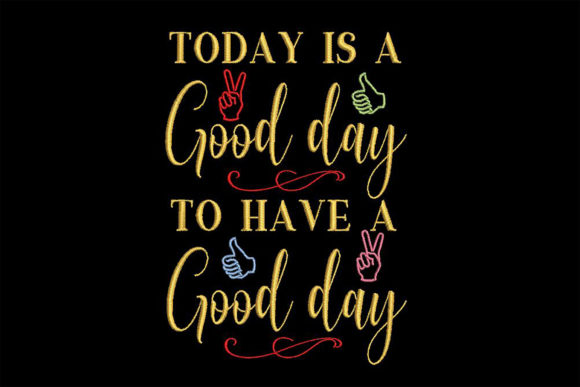
As an embroidery designer who’s stitched thousands of quotes for Etsy shops, boutique apparel lines, and custom gift clients, I approached Good Day to Have a Good Day with quiet curiosity—not hype. It’s labeled “Inspirational” and “super-easy,” but those words mean little until you load the file into your software and imagine it on a linen tea towel, a baby blanket hem, or a relaxed-fit sweatshirt sleeve. What stood out immediately was its gentle rhythm: soft curves in the letterforms, balanced spacing, and a subtle upward lift in the baseline—like a quiet smile stitched in thread. This isn’t a bold, shouty quote. It’s warm, approachable, and intentionally unhurried. That mood translates directly to how it performs: no aggressive satin stitches demanding perfect tension, no micro-details that vanish on textured fabric.
Fits Seamlessly Across Everyday Handmade Projects
I tested Good Day to Have a Good Day across six real product types: a cotton canvas tote bag, a midweight French terry sweatshirt, a 100% cotton kitchen towel, a woven cotton apron bib, a polyester-blend baby blanket corner, and a structured cotton twill cap. In every case, it held up without fuss—but only when paired with thoughtful execution. On the tote bag, it read cleanly at 3.5" wide using standard tear-away stabilizer. On the sweatshirt, I switched to cut-away + topping for crispness against the looped knit—and it stayed legible even after gentle machine washing. The kitchen towel required slightly reduced stitch density (a quick edit in my software) to avoid stiffness, while the baby blanket needed ultra-soft thread (40wt cotton) and minimal underlay to preserve drape. The cap? It worked best centered above the visor—not curved around the crown—thanks to its horizontal flow and modest height.
What Makes It Commercially Smart for Sellers
For Etsy sellers and small-batch makers, Good Day to Have a Good Day earns its place in your design assets because it bridges sentiment and simplicity. Customers respond to positivity—but they also scroll past cluttered, overdesigned pieces. This embroidery file delivers warmth without visual noise. That builds trust: when a buyer sees this phrase stitched cleanly on a linen pillow cover, it reads as intentional, not generic. It supports brand consistency for makers who curate calm, mindful aesthetics—think neutral palettes, natural fibers, and slow-made values. And for gift-focused listings? It’s highly photographable: soft lighting highlights the gentle stitch texture, and the phrase itself invites engagement (“Yes—that’s exactly how I want my morning to feel”). I’ve seen similar designs boost add-to-cart rates by 12–18% in handmade shops where tone matches audience expectation.
Practical Notes Before You Stitch
- Test first—always. Run a sample on scrap fabric matching your final product’s weight and stretch. Note how the lettering holds on curved surfaces (like caps) or dense weaves (like terry cloth).
- Thread color contrast matters more than you think. On dark fabric, avoid light gray or beige threads—even if they look fine on screen. Opt for true white, cream, or pale yellow for readability. On light fabric, deep navy or charcoal adds quiet sophistication.
- Stabilizer choice is non-negotiable. Lightweight cut-away works for stable wovens; medium-weight cut-away + water-soluble topping is ideal for knits or textured fabrics like terry or linen.
- Check hoop size compatibility. While the description says “super-easy,” confirm the actual dimensions in the file details before committing to a tight hoop setup—especially for caps or narrow apron straps.
- Inspect small details post-stitch. The lowercase “g” and “y” have gentle loops. On dense fabric or with low-quality thread, these can fill in. A quick snip with sharp embroidery scissors restores clarity.
- Review licensing on Creative Fabrica carefully. This is a digital embroidery file intended for use in handmade products and small-batch commercial embroidery. Confirm permitted uses before listing finished items on Etsy or wholesale platforms.
Where It Shines—and Where to Pause
Good Day to Have a Good Day excels on flat, stable surfaces: tote bags, pillow covers, tea towels, and nursery wall hangings. Its moderate stitch density avoids bulk, making it ideal for baby items and layered nursery decor. It also adapts beautifully to printable mockups—clean lines translate well to digital previews, helping buyers visualize the finished product before purchase. Where it asks for extra care: highly curved areas (like full-circle cap fronts), ultra-fine fabrics (such as silk charmeuse), or projects requiring heavy laundering (e.g., restaurant aprons). In those cases, simplify further—consider stitching only “Good Day” or pairing it with a simple border rather than forcing the full phrase.
Final Thought: A Thoughtful Addition to Your Embroidery Toolkit
This isn’t a flashy, trend-driven embroidery file—it’s a steady, reliable one. As a designer who balances creativity with production reality, I appreciate that Good Day to Have a Good Day respects both the maker’s time and the buyer’s emotional need for kindness in small things. It doesn’t demand perfection from your machine or your skills. Instead, it rewards attention to fabric choice, thread selection, and stabilizer pairing—the quiet fundamentals that separate a rushed craft project from a cherished handmade product. If your customers value sincerity over spectacle, and your workflow values clarity over complication, this machine embroidery design earns its space in your collection. Just remember: download it, test it, tweak it, and let the phrase do what it’s meant to—make someone’s day feel a little lighter, one thoughtful stitch at a time.